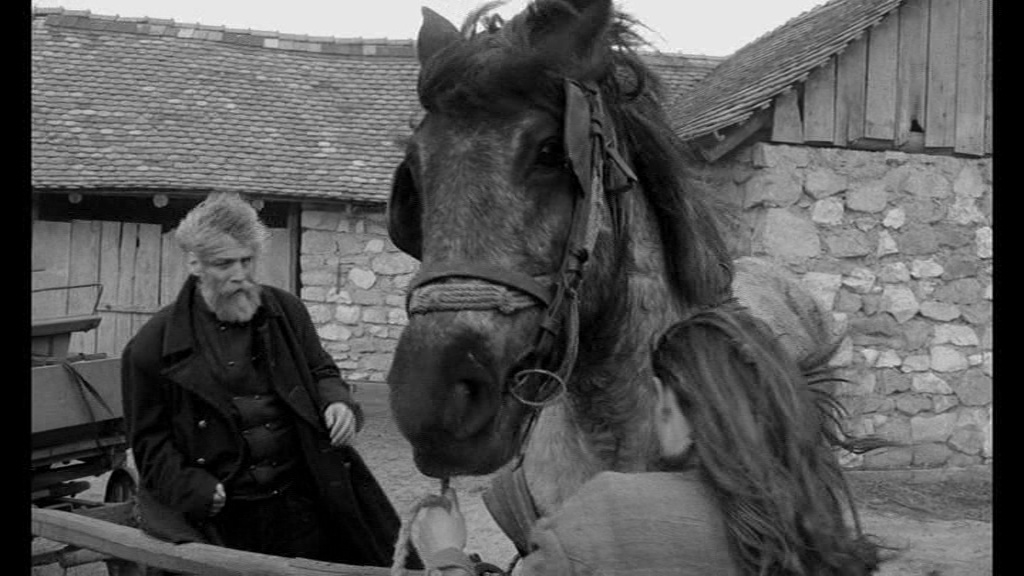
The Turin Horse is a 2011 Hungarian film directed by Béla Tarr and Ágnes Hranitzky.
Turin Horse is the most philosophical film I have ever watched. It is indeed a great work of art. Every frame is like a painting or a work of art

I am going to discuss the philosophical significance of Turin Horse. I see it as a representation of Nietzsche’s philosophy, especially the thought experiment of Eternal Recurrence. There is an instance in the life of Nietzsche where he embraced a horse in the street of Turin which became a life-changing event in his life. Nietzsche goes mad after this event. The ailing horse in this film seems to be a link to Nietzsche. No doubt, the character of the old and dying horse, is really haunting.
The central theme of this film is Nietzsche’s idea of the aesthetic justification of existence in a world which is not goal orientated and absurd. He says that existence can only be justified as an aesthetic phenomenon. Earlier Schopenhauer gave us a pessimistic response to the life but Nietzsche gives us an aesthetic response to life. He asks us not to deny life but to embrace life with all its seasons of pain and joy. The embrace of horse is metaphorically the embrace of life which seems to be pointless.
The thought experiment of Eternal Recurrence is discussed in this film. According to this thought experiment, we are asked to live the same life multiple times. It means I need to live the same life again and again by going through the same experiences, endlessly. Such a future seems to be boring and pointless. The different characters in this film respond differently to the problem of eternal Recurrence. The gypsies are very passionate about such a life and they are people with overflowing energy. They don’t get stuck with any particular place or individual. The neighbour who visits the home of the old man is very passionate and responsive. At the same time, the oldman and his daughter are living the same life every with the minimum requirements. Sometimes they do the things that do not seem to work out. They even try pointlessly to ride the horse cart with a dying horse. They are not passionate about life and as a result they are reluctant to make changes in routine. There is no room for innovation. At the same time, they give the impression that minimum needs in life is the right response to life. They eat the same kind of food everytime and every day appears to be a repetition of the previous day. There is no aesthetic response in their daily lives. It further shows Heidegger’s idea of the average everydayness of Dasein. In its average everydayness, Dasein falls to the stage of idle talk and laziness. What is the aesthetic response mentioned by Nietzsche in his writings? Is it the mainstream understanding of aesthetics where we create beautiful work of art and poetry? Can we live our lives aesthetically in any other ways? This film gives a different response to the aesthetic response to life. What I understand is that aesthetic response to life can be considered as a presence to the present moment. Even though they repeat the days, every day is not the same, philosophically. Every day is different and the individual who performs the action is different. As Heraclitus said “we can’t swim in the same river twice.” Nietzsche’s idea of aesthetic response must be an undivided attention to daily life and its activities even though they are repetitive.
The cinematography of this film is excellent. Every frame is well thought out. Sometimes the camera movements are very less, camera is still sometimes, and sometimes the camera does not follow the characters. Turin horse indeed is a poetic rendering of the life and philosophy of Nietzsche.
Reviewed by Joseph Kala


 KALA
KALA 
Leave a comment