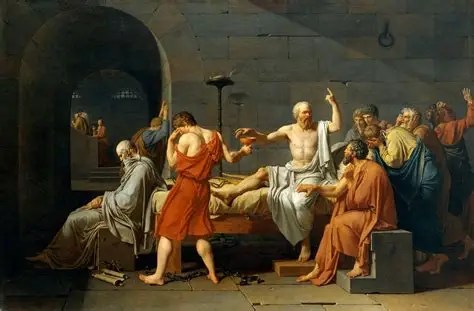
Socrates did not write a single book, and he never published articles in any reputed journal of his times. He did not even start universities like his predecessors. Still, he is considered as the father of Western philosophy. There were philosophers in the ancient Greece before Socrates who were called as pre-Socratic philosophers. In this article, I try to highlight the significance of the philosophy of Socrates in the times of technology and artificial intelligence. I think that his philosophy or way of life is still relevant.
Pre-Socratic philosophers are the thinkers who existed before Socrates. Pre-Socratic philosophy is an umbrella term used to denote the thought of various philosophers like Thales, Parmenides, Anaximander, Anaximenes, Heraclitus, Pythagoras, and so on. We do not have access to any of their writings. Socrates found that the natural philosophy of pre-Socratics lacked a technology of self or meaning-making mechanism. Philosophy of Socrates is a radical departure from the tradition of the pre-Socratics who were concerned about the ultimate stuff (arche) out of which everything else is created. They can be called as scientists in the modern-day terminology as they had deep scientific temper in their approach to the world. The concern of Socrates was not anything like metaphysical questions, but he was deeply concerned about the technology of self or the way to live a meaningful life.
Socrates is known as the philosopher of the marketplace. He was never like an academic philosopher of our times, but he used to hang out with young people in the market. He engaged in deep conversations with people who claimed to be experts in different domains. His method of conversation is generally called as “dialectic” which proceeds through questioning. For example, in the Dialogue titled, Euthyphro, Socrates is engaged in a conversation with Euthyphro who claimed to be an expert in moral theology. Socrates asked Euthyphro to explain “what is piety?” but Euthyphro failed to give him a convincing answer. Socrates found internal contradictions in every response given by Euthyphro. Towards the end of the Dialogue, Euthyphro comes to know that it is impossible to give a definition of the concept of ‘piety’ and he escapes by saying that he is busy with some other work. In general, Socrates dragged the interlocutors to ‘aporia’ which is a kind of intellectual perplexity where you are not certain about your own set of beliefs. It is believed that Socrates was always in aporia and he tried to spread it around him. He was considered to be the wisest of all Greek men. Socrates acknowledges that he is considered to be wise by the deity because he knows that he does not know anything. According to Socrates, the greatest of all knowledge is the knowledge that we do not know anything. This idea is similar to the Advaita view that highest knowledge is the knowledge of no-thing. In short, Socrates invites us to gladly welcome the uncertainty which lies at the bottom of our existence. He questioned everyone who defended the idea of certainty concerning knowledge claims and existence.
Socrates was prosecuted for misleading the youth of Athens. He was accused of turning the youth against the State and God. He replied that he was teaching the young people to “take care of themselves.” What does it mean? Alcibiades is a Socratic dialogue where Alcibiades, a young Athenian approaches Socrates to express his ambition to begin his political and public life but he does not know anything about it. Socrates asked him to submit himself to his lover, Socrates. The love here is not physical love but intellectual love. “Taking care of self” is the intersection of political ambition and philosophical love.
In 127 d of the Alcibiades, we come across the phrase of epimelesthai sautou, which means to take care of yourself. Epimelesthai means more than just paying attention to something. Foucault says, “Epimelesthai expresses something much more serious than the simple fact of paying attention. It involves various things: taking pains with one’s holdings and one’s health. It is always a real activity and not just attitude. It is used in reference to the activity of a farmer tending his fields, his cattle, and his house, or to the job of the king in taking care of his city and citizens, or to the worship of ancestors or gods, or as a medical term to signify the fact of caring. It is highly significant that the concern for the self in Alcibiades I is directly related to a defective pedagogy, one which concerns political ambition and a specific moment of life.” Socrates tells Alcibiades that the foundation of political life lies on an effort to know the soul. Foucault further says, “The effort of the soul to know itself is the principle on which just political action can be founded, and Alcibiades will be a good politician insofar as he contemplates his soul in the divine element.” Alcibiades should try to know himself in order to become a good politician. To take care of yourself consists of knowing yourself. The idea of Socrates is that being occupied with oneself is linked to political activities. Towards the end of the dialogue, Alcibiades comes to the understanding that he should first “take care of himself” before beginning his public and political life. This taking care of the self begins with examining the soul.
His entire philosophy can be summarized with this quote: “An unexamined life is not worth living.” What did he mean by the idea of an unexamined life? An examined life means a life which is properly lived. It can be said in another way that a life of bullshit is not worth living. Bullshit can happen when we do not have the capacity to realize the relevant things in life. As we lack this capacity, we tend to live our lives doing a lot of irrelevant things. According to Socrates, a life full of such bullshit, is not worth living.
The essence of the philosophy of Socrates is that we should take care of ourselves. It means that we should make an attempt to know ourselves. This ‘self-care’ has both physical and psychological senses. In addition to that Socrates invites us to embrace the uncertainty lies at the bottom of existence. This idea appears in the philosophies of Kierkegaard, Nietzsche, and Heidegger.
Joseph Kala



 KALA
KALA 
Leave a comment