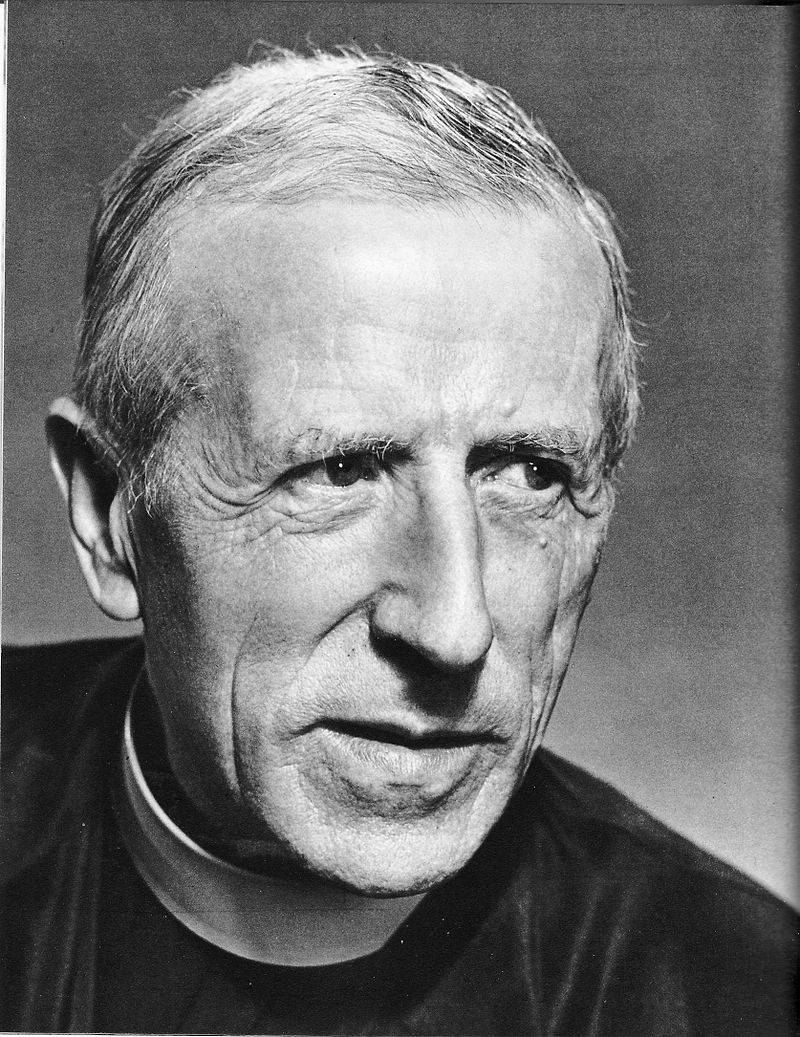
As we advance in life materially, the intensity of evil and suffering is on the rise. Modern technology could not eliminate evil from the world. With new technologies, complex types of evil arise. How do we accommodate evil in this world? There are many traditional and religious views on the meaning of evil. Here I do not want to subscribe to any of those views. This paper looks at the concept of evil with a Teilhardian worldview. A discussion on the concept of evil becomes impossible without a reference to Teilhard’s worldview and idea of evolution.
Worldview
The concept of worldview has its roots in the German word Weltanschauung. The term composed of Welt (‘world’) and Anschauung (‘view’ or ‘outlook’). It is a concept fundamental to German philosophy and epistemology and refers to a wide world perception.
The Weltanschauung of a people originates from the unique world experience of a people, which they experience over several millennia. The language of a people reflects the Weltanschauung of that people in the form of its syntactic structures and untranslatable connotations and its denotations.
Worldviews are not prisons which contain and constrain us, they are the spaces we develop within. According to Job Kozhamthadam, worldview is the framework of ideas and belief through which an individual interprets the world and interacts with it. It involves explicit and implicit presuppositions .It is the background of all religious, political and cultural dimensions. It unconsciously controls us and influences our knowledge and meaning system.
According to Martin Heidegger, our worldview is rooted in the earth where we dwell. The world of a person is not the planet earth. We can say that our worlds are built on the earth. Our worldview gives shape and form to the earth. According to Heidegger, Van Gogh’s Shoes talks about the world of the peasant women. The world of the peasant women is emerging from the earth. The pair of shoes represents the world of the women. Since the earth is not a passive entity that allows it to be easily shaped into a world there is a constant strife exists and as a result the world always changes. According to Heidegger’s view, world and earth always exist in a tension or a strife which is eternal in nature. Heidegger believed that nothing lasts forever precisely because the earth resists incorporation into a world. In the later writings of Heidegger explain that different historical epochs as having fundamentally different worlds that succeed one another. A single world created on earth cannot last long, in course of time it will be replaced by another world. For Heidegger, the succession of such worlds is accounted for by the fact that the earth resists the attempts by a world to hold it steady, to incorporate it into a static structure. Anais Nin expressed through her numerous writings that life is a process of becoming, a combination of states we have to go through. Where people fail is that, they wish to elect a state and remain in it. This is a kind of death.
Succession of worldviews
Copernicus published heliocentric theory in 1543. That led to gradual dethronement of Christianity and enthronement of science. In Middle Ages science was almost controlled by the Church. Religion controlled science almost for 1500 years, till sixteenth century renaissance. There was a domination of Aristotelian philosophy, geocentric by Aquinas. Aristotelian science is challenged by Copernicus. With Galileo Copernican theory became strong. Heliocentrism is accepted and geocentrism is rejected. Thomas E, Wartenberg said,
The heavens themselves refused to obey the received version of God’s will. The Earth, far from being the center of the universe, was not even the center of the local planetary system. Astronomy seemed to show that the divine plan, whatever it was, was much bigger, much more diffuse, and much less concerned with ‘God’s Earth’ and ‘God’s creatures’ than the church would ever be willing to concede.
By sixteenth century renaissance the uncritical worldview which is dogmatically proclaimed by the church for nearly fourteen hundred years was rejected. There was now a growing emphasis on the importance of the rational capacities of the individual, and on natural ways of coming to know and understand. Mathematics, deductive and inductive reasoning, and empirical observation came gradually and imperceptibly to be held in greater esteem than some of the doctrines of the Christian church. The enlightenment tradition emphasized the rational powers of individual to discover the truth in order to determine autonomously what is and what is not morally required of them.
Background of Chardin
The twentieth century is characterized by a number of different developments like, the astonishing development of science, advent and growth of communism, freedom from/end of colonialism (downfall of European Christian Empire), rise of evolution as an accepted scientific theory with a world view, advent and spread of positivism and modernism and its spirit.
Salient Features of Teilhardian Worldview
Teilhard was an original thinker and he did not accept any ready-made categories and worldview. So his original ideas may not be able to satisfy some of the problems existing as a result of many other worldviews and systems of thought. That of course brings certain amount of ambiguity and vagueness. One sad fact is that Teilhard was not allowed to publish and teach and that prevented him to express his ideas and to better his ideas with challenges and criticism from his readers. Critically looking at the ideas of Teilhard is a herculean task as he is a theologian, scientist and philosopher and I would say that he is a poet too. Only a good musician can give the critique of a piece of music.
The dilemma confronting him was how he could reconcile love for God and love of the world. He was thinking about the reality which at times seems to be terrifying and brutal. It drags the human beings along and kills with complete indifference. World sweeps away all of a sudden what we have built laboriously with putting all the love, beauty and intelligence. In such a world where human life becomes insignificant, Teilhard wanted to find out a way out. As a result he developed an all embracing evolutionism and all penetrating Christianity. Teilhard developed an integral approach to science, philosophy and Theology in order to construct a vast picture of the world.
Two fundamental principles of Teilhard
- Christ
- Evolution
Teilhard’s view of the world is an evolutionary one with Christ at the centre. It would be closer to the truth to say that his evolutionary perspective is an extension of his faith in incarnation. Evolution is not yet finished, but will continue to develop to higher states of personality. Evolution is a continuous and a different phenomenon from revolution where the past may be completely overthrown, whereas evolution is a gradual and progressive process. Here we need to define creation and evolution, creation is not the production of a world fully made in some primordial moment, nor yet is it the bringing into existence of ‘being’, which changes and develops but is fully created to begin with. But creation is an action in which God brings things into existence through the process of union which we call evolution.
Teilhard never disputed the traditional notion that God creates ex nihilo, creation out of nothing. God, the omega is ultimately responsible for evolution. Evolution is from matter to life to man, and the continuing evolution of mankind. The end goal of creation is the transformation of the products of evolution, spiritual beings, into the matter of Christ; Christ is to be identified with ultimate summit of evolution. Creation is for its own sake. It does not add anything more to the perfection of Divine; it is just an act of love. In advaita tradition, we find the Divine play (lila) where the Divine plays for its own sake. God is entirely self sufficient and yet the universe brings him something vitally necessary.
What is responsible for evolution?
The driving force behind evolution is the penetrating influence of Christ – omega or the will of god or the spirit of God, This energy is instilled into beings to animate them and order them towards their end. This union reflects the union within the trinity. The progress of evolution depends on the cooperation of mankind, the pressures from outside, and the work of the Holy Spirit within us. We can either promote or distort the work God is making. Here individual freedom is respected as we are free to react either positively or negatively to the pressures to which we are subjected, to move towards either greater or lesser personality. We are free to cooperate with or to resist the Holy Spirit within us, to move towards a closer union with God and the rest of mankind or to move away from God and the mankind.
Teilhard develops a concept called ‘self-giving’. It is a necessary pattern for any true union in all dimensions of existence. This is even manifested even in the triune god, which is not resulting in any loss, but gain. Our refusal to give oneself results in all destruction and loss. Goodness in this world is more than the evil. If we can hinder the purpose of God then we can also further them. We need to give ourselves so that to God that Christ can be born through us, that the whole universe is transformed into the body of Christ.
Teilhardian Idea of evolution – Creative Evolution
Teilhard built up his own brand of evolution. Evolution is orthogenetic, that is, evolution is directed towards a goal. Evolution is a process that has got a destiny. For Darwin evolution has no direction. Teilhard believed that God is creating the world by means of evolution. Teilhard calls it as ‘creation evolutive’ – and that this creation is moving from a state of nothingness, which is characterized by complete dissociation towards complete personal union with God in Jesus Christ. Teilhard believed that creation is evolutive and not evolution as creative. God is bringing his creation to ever higher states of being. His evolution is more philosophical evolutionism than any genetically oriented or mechanistic approach to evolution.
Phases of Evolution
According to Chardin evolution passes through four stages or phases,
- Lithosphere (non living sphere)
- Biosphere (Living sphere)
- Noosphere (Thinking/mind sphere)
- Omegasphere (Culmination)
Creation for Chardin is unification and complexity increases at a particular level some characteristic associated with life is shown. That characteristic is thinking. Matter and spirit are coterminous that is they begin, grow and end together. There is no inert matter for Chardin. At a certain complexity level, ensoulment is shown that is the thinking is shown. Convergence, the development from one sphere to another stops at when the omega point is reached.
Evolution is more internal that external – Evolution is the development of the spiritual. There is a kind of impulse or urge inside the organism. The body or morphic part adjusts itself according to the impulse; Teilhard borrowed this idea from Lamarck. But Darwin gave a mechanical interpretation that is purely natural selection. According to Job, Teilhard is more Lamarckian than Darwinian.
Evolution is continuous – Physically in general evolution is almost over. Psychically evolution is continuous. Evolution is continuing with the noosphere (thinking). Now mind only develops.
Evolution is theistic – God is an integral part of the evolutionary process he is the alpha point and the omega point.
Vitalization – It is the coming of life.
Hominization – coming of humans , self conscious and reflective beings. The instantaneous leap from instinct to thought constitutes the process of hominization.
Ensoulment – Teilhard does not speculate any divine intervention but he affirms ensoulment. A higher degree of change took place that is a drastic one in nature. High intensity change resulted in ensoulment.
The ‘Within’ and ‘without’
Every being has two aspects, the ‘within’ and the ‘without’. Within is the immaterial conscious aspect. And without refers to the material and measurable aspect. Although everything in the universe has a within and a without, the development of within with respect to the without varies. The within is best developed in man, the most complex entity in this universe. Within aspect becomes more and more prominent as we go to higher beings.
The law of complexity consciousness (Teilhardian Law)
This law is related to the ‘within’ and ‘without’ aspect. There is a direct relationship between complexity of the being and the level of consciousness of beings. The more complex a being the more complex its consciousness. Consciousness of a protein molecule is not perceptible for human beings. Consciousness of an earthworm is higher that the consciousness of a protein molecule.
Two energies
Two energies are operating in this universe. The most fundamental energy is love. The two energies are the components of love.
Two energies are
The radial force
- (vertical) Takes the united beings forward and upward
Radical is responsible for progress and growth.
- Tangential force (horizontal) – It unites being of the same kind and it is the agent of unity and it is the unifying factor.
Love is the resultant force of the two. (a resultant force between those two as in physics).
Omega Point
Evolution is an ascend towards a higher consciousness. The future of the mankind could be in one of the two dimensions. It could be either along a divergent or along a convergent path. A divergent path would lead to a state of diffusion of consciousness and this Teilhard dismisses. But convergence must lead to a definite point or a state of integration and that is Omega. Thus omega is the final destination of the evolutionary process. It is the centre of the centers. Process stops at the convergence at omega point. At Omega point the within would have defeated the without and so would there exist solely of a collection of individual consciousness. There will be a convergence of all consciousness into a supreme consciousness at Omega.
Characteristics of omega point
Person – Omega point is a person and it is not an idea or a point. It is not an abstract philosophical idea. Only a person is capable of love. Love exists between people. It is a point of love and a loving person.
Omega is transcendent – Omega transcends. It goes beyond .Omega point transcends the process of evolution. It is not a product of evolution .Evolution does not create omega point.
Autonomous – Omega point has certain autonomy. It is independent.Omega point is irreversible.
Christ Omega
Teilhard brings religion or Christ per se only here. The actual omega point comes from religion. Specifically from Christianity. Omega is a personal being that is Jesus Christ. Only Jesus Christ can bring omega point. Only possible through Roman Catholicism and the axis of evolution passes through Rome. The Omega is Christ or God. It is already in existence and is loving and lovable at this very moment. Emile Rideau explains that Omega is actual and present now, so that it can exercise an attraction of love on beings and minds.
Teilhardian Worldview – Scientific, Dynamic, Cosmic and Evolutionary
Teilhard developed a dynamic worldview. Evolution or change is present in all level and dimensions of beings like matter and thought. Everything is under the law of evolution. Things come to perfection by a gradual process. Change is understood as fundamental and not a sign of imperfection or inferiority. The universe is imperfect but a perfectible universe. There is a forward looking destiny, when everything is fulfilled the best world will come. Complete certainty and exactness is unattainable in a dynamic world view of Teilhard.
Concept of Evil
This paper focus on the way Teilhard understood evil. Most of the religious traditions like Christianity, Hinduism and Zorashtriansm have doctrines on evil. Bhagavadgita metaphorically talks about the strife between goodness and evil within the heart of the believer. Here we need to look at evil in a different way to understand and accept the reality of evil around us. I ask this question to myself always. Why do we violate laws and do evil against our own brothers, even though we have moral norms within. We know that what is not good for us is not good for the other too. According to Kantian notion we shall not limit the other to the same. We shall not treat others are not means but as end in themselves.
That in the order of ends, man (and with him every rational being) is an end in himself, that is, that he can never be used merely as a means by any (not even by God) without being at the same time an end also himself, that therefore humanity in our person must be holy to ourselves, this follows now of itself because he is the subject of the moral law.
The same Kant could not defend the evil done by the Europe against the African continent. Then who is the other and what is the good act is always a difficult problem to be discussed. Human beings are composite beings. We are made of matter with a complex state of evolution. Still as we go to the quantum level we find the disorder and uncertainty existing. Here we are going to look at the view of Teilhard Chardin.
Concept of Evil in Teilhard’s Worldview.
There is no systematic treatment of the problem of evil in the writings of Teilhard, either published or unpublished. There is a diary entry on Dec 1917 that he is planning a study, that would cover all the major aspects of evil. But the plan was not materialized. Still we find his insights on evil in different writings, published and unpublished. The question of evil is a mystery and we can have closer and clearer look at it and cannot fully solve it. According to Job, Teilhard’s approach to evil with a dynamic worldview perspective, makes the issue of evil less mysterious. Evil remained a mystery to Chardin. Evolution contributes to the solution of the problem of evil by giving a vastly increased insight into the nature of the mystery.
According to Teilhard, the advances in modern technology magnifies the forces of evil. Evil increases with the advance in evolution. The more man becomes man, the more the question of evil adheres and aggravates, in his flesh, in his nerves, in his spirits. Evil is so closely related to the advance of evolution that it might also be included in the formula, as varying in direct proportion to complexity and consciousness.Evil is a movement which opposes or limits the growth of complexity and consciousness or the personal.
Good and evil
Teilhard defines good and evil in terms of evolutionary process. Good is that which helps us progress towards the increase of complexity and consciousness. It can also be defined as that which tends towards further development of the personal. Evil is that which retards or opposes the development of the individual and the society. Immobility and indifference is a great sin.
Evil is an inevitable accompaniment to creation. In Science and Christ, Teilhard said, ‘God seems to have been unable to create without entering into a struggle against evil’. Evil is not the will of God but it is something he will ultimately overcome. Presence of evil is not because of any defect in God’s power or goodness or in his love for us and concern for our well-being, but because of the nature of the creation itself.There is a greater quantity of evil and more serious quality of evil to be found at the higher states of evolution than at the lower ones. Human evil which is the evil at the highest point evolution has so far reached, is for more serious matter that pre-human evil. Evil appears in an especially acute for at the highest point of evolution.
A search for the place of evil
The search for the place of evil in an evolving world is a meaningful task. But it becomes meaningless in a world that is static and cyclic where the evil is ‘there’. In such a perfect world evil does not exist. The development of evil and its functions in an evolving world has to be understood. The evil would only be a scandalous in a static cosmos conceived of as emerging complete, directly from God’s hands.
Three Kinds of Evil.
Teilhard speaks of three kinds of evil as a part of the total phenomenon of man in the universe.
Evil is a tendency towards disorder or disunion – this is an evil of disintegration found in all beings in this universe along with a tendency towards order and disunion. Here we need to understand that the entire humanity as an interconnected entity. We cannot tolerate only one portion advancing in evolution and another portion falling back to a lower level. What affect one affects all.
Physical Evil – This is the evil of suffering and pain. It is found in all living beings. Teilhard’s main concern was to show how suffering may be transformed and used constructively, by offering it to God for the advance of the world, to bring out to a greater extent the ‘within’ the spiritual aspect.
Moral evil – This is specific to beings with freedom to make choice and self-evolution. It is a conscious return to the multiplicity or a descent from a more unified to a less unified state; it is a stumbling block before the further evolutionary advance. It is a human form of evil. It originates in man. It appears as a turning aside from the true line of advance.
Why is there evil in this world?
Evil is present in an evolving and hence incomplete world as a natural phenomenon. Evil is a by-product of evolution. It is a side-effect of creation or cosmogenesis. In an evolutionary perspective the existence of the three above mentioned evil are natural. Disorder and the tendency to disunity are clearly the part of the material basis on which evolution is built. Evolution presupposes certain amount of disorder and disunion and if there is a perfect union already, evolutionary process becomes meaningless and no job to perform. According to Teilhard, evolution, by its very nature progresses by the method of trial and error. Hence chances will be taken and naturally there will be many failures and hence we can account for the existing moral evils in the society and in individual. Though the material world is ever progressing and advancing, the rate of evil increases. Our experiences of the past becomes a lesson for us and learn many things from the errors that no the same great error happen in the future. Chauchard explains as, man, no longer having sound animal instincts, must learn how to behave like a man.
Evil is Natural and Spontaneous
The world which is a becoming than being, witnesses the spontaneous and natural occurring of evil. Physical disorders and decompositions in the pre-living beings, suffering and pain in the living beings, and sin in the free beings are the price to be paid for every success made in cosmogenesis.Teilhard is concerned about this very world, a world with inherent evil. He did not want to explain the way an omniscient God creating a world with inherent evil. Evil appears necessarily and abundantly in the course of evolution. It is not an accidental happening but through the very structure of the system. Evil thus becomes a by-product of evolution. J B Kopp explains in Teilhard de Chardin Explained that in universe, imperfection is a part of the process. The ordering necessarily includes some disorder at every stage. Thus evil is a ‘structural stress’ of evolutionary creation.
Teilhard explains evil with a different perspective in Phenomenon of Man.
Evil of disorder and failure – Evolution advances by means of unpredictability and chance, with the result that checks and mistakes are always possible. For every one success in evolution there are many failures. Just as one moment of joy requires hours of sorrow. At every degree of evolution we find evil always and everywhere. In short, evolution proceeds through a trial and error method.
Evil of Decomposition – Evil originates from the disunity at the base of evolution. Its elementary forms are the decomposition and development in directions that prohibit further advance. The disorder and tendency to disunity are clearly part of the material basis on which evolution is built. Evil extends from there throughout creation. Pain and suffering are the transformation of this elementary form of evil at a higher stage of being. Thus we know that evil has a quite reasonable place in a world which is in evolution. There he explains death as the regular, indispensable condition of the replacement of one individual by another along a phyletic stem. Death is the essential lever in the mechanism and increase of life.
Evil of solitude and anxiety – This is the great anxiety (peculiar to man) of a consciousness wakening up to reflection in a dark universe in which light takes centuries and centuries to reach it is a universe we have not yet succeeded in understanding either in itself, or in its demands on us.
Original Sin
Original sin is the evil did not originate with mankind. This is a cosmic situation of the fall of man. The serpent is a representative of nature, evolution before man with its limitations and tendencies to disorder. Natural evil is not the direct cause of sin, but it may provide a temptation to sin. The traditional doctrine of original sin describes sin as the cause of disorder and the tendency to turn from God. Teilhard reverses this concept and said that sin is the effect of disorder.
Teilhard considered original sin as a cosmic situation than an accident or event of a particular person at a particular time and space. Christianity considers original sin as a cosmic event in the Garden of Eden than a cosmic situation. According to Faricy, the negative forces of counter-unification, which were at work long before mankind became conscious in mankind. According to RB Smith, original sin is the essential reaction of the finite to the creative act. We bring Newton’s third law of motion for a better understanding of this reality for every action there is an equal and opposite reaction. There can be opposite actions against the creative evolutionary acts. The world is an unfinished product and it has always an inherent tendency to resist God and move backwards. We understand that evil existed even before man came into being.
Personal Responsibility
In an evolving universe where evil is inherent cannot define the personal responsibility of the individual for doing evil act. Then who will take up the responsibility for the numerous evil done against the humanity? Are we becoming just a passive instrument in the hands of the process of evolution? Is the creator then responsible for the evil? Teilhard could not give any satisfactory explanation. Evil is placed on god’s method of creation. Man too has to bear some of the guilt and pay the price for what he does, I think. Teilhard considers evil as a part and parcel of the natural process and not as a disruptive intrusion within the process. The Fall is essentially a symbol of world’s incompleteness and not a historical event separating man from God.
Richard Dawkins says in his book The Selfish Gene, that genes are just playing with us as they are in the process of evolution and the numerous data is to be communicated to the generations. It is something like the survival of the fittest. The genes may take up any means to achieve the goal. The sole purpose of the gene is to transfer the numerous genetic data waiting to be evolved.
Concept of sin
In most of the religious scriptures we find that sin is the cause of disorder. This can be found in the instance of the original sin of first parents where they were banished from the paradise as a result of the sin. In Teilhardian perspective, disorder is understood to be a counter action against the unity and sin is the refusal to be in unity. Traditional theories believe that sin came to this world just because of the sin of the first parents. But according to Teilhardian understanding sin existed even before the appearance of man on earth.
Welcoming evil
In Mystical Milieu, Teilhard seems to have welcomed evil, at least in some of its forms, and hailed it as a friend.
Blessed then be the disappointments which snatch the cup from our lips; blessed be the chains which force us to go where we would not. Blessed be relentless time and the unending thralldom in which it holds us… Blessed above all, be death and the horror of falling back into the cosmic force.
The different attitudes of Teilhard to evil must be understood in their own relation to the central and unifying concept of evolution. God is able to take and use evil for his purpose and in a way evil must be welcomed. Not as evil as not evil. Evil must be prevented. God uses it to bring about good and there is a bright side of it. Teilhard explains our attitude towards cross in The Divine Milieu as the cross is therefore not inhuman but superhuman. Once we have fully grasped the meaning of the cross we are no longer in danger of finding life sad and ugly. The Christian, ultimately is not asked to faint in the shadow but to climb in the light of the cross.
Destiny of Man, Evil and Universe
Schopenhauer, rightly portrayed as a moral pessimist, believed that there is no escape from suffering now or in the future, because the nature of the world in reality is eternal self-conflict. But Teilhard believed that evil as a force of disintegration cannot conceivably continue to increase indefinitely into the future and reach the Omega point together with the personal being. Evil must be ultimately disappeared or overcame by good. When creation is complete, evil will have been completely overcome. The aim of the writings is to give hope to humanity that evil cannot finally triumph. A universe with total death will not make any sense. We come to an escape from all kinds of evil through joining in a center-to-centre union with Omega.
Christianity believes in a better world existed which is polluted by human beings and is being saved by the incarnation and the purifying acts of the Catholic Church. Leibniz believed that the present world is the best possible one. According to Teilhard, it is this world that the God is going to perfect and to make the best possible one through the process of evolution. This imperfect world could be perfected by God. Aquinas was wrong in believing that this world cannot be improved.
Overcoming Evil by Cooperating with God
Human action in overcoming evil is important. We cannot leave future entirely to God. God’s plan for us includes our cooperation. God does not compel us to come to him but his love draws us. We need to cooperate in order to bring creation to a successful outcome. We need to have openness to others. Mankind advance as a whole and hence we need to go beyond our own little individualities. The within aspect has to be developed for the development of human consciousness and personality. We need to remain open to the further evolutionary development and the developments in science. Scientific advance can only serve to enhance personal values. Be fully united with each other and with God in Christ. We need to be ‘broken open’ that God’s love may take possession of us.
Conclusion
Teilhard develops an aesthetic view of the world. According to Emile Rideau, Teilhard as an artist and a poet himself explained the essential part played by the creation and contemplation of the beautiful in the spiritual development of consciousness and in the progress of mankind. I would say that the traces of Teilhardian aesthetics are found in his works. It was the merging of the world with the body of Christ. Jones written that Teilhard had a vision of Christ, in which he saw the outlines of a painting of Christ merge into the rest of the world. At Omega creation as a whole becomes beautiful. According to Fr. Job, the duty of a scientist is to discover the beauty and grandeur of nature and that is found in the life and works of Teilhard.
Teilhard develops a mystical worldview where at the Omega all the dualities and pluralities disappear and a unified approach to the reality will emerge. And reality is understood as the play of the Divine being, where the Divine creates not for any personal gain but for the sake of play. The entire universe becomes the body of Christ where there is a union between the world and Christ. Teilhard offers us a world loving or affirming philosophy than a world negating philosophy where God is hidden but discoverable right at the heart of matter. The distinction between the sacred and the profane disappears here.
Teilhard speaks about a world of love. Love is manifested as the most powerful force at each and every degree of evolution. Here the universe is understood to be charged with love. The whole earth will be covered by the ideal society which Teilhard calls the noosphere where social relations are based on love. It is an agaposphere. Teilhard speaks about a social dimension of life as mankind advances as a whole and hence we need to go beyond our own little individualities.
Teilhard believed that suffering has a key role to play in the process of evolution to unification. A life without any tension will become so passive that human beings miss the beauty of life and it results in individualism and multiplicity. But each and every suffering and evil challenges us and unites us. Evil asks us to be united in spite of all the differences and human beings stand together against a common enemy like terrorism and corruption to make a better world. Each war and inhuman act proclaims the message of the growing need of union and togetherness.
Bibliography
Chardin, Teilhard. Writings in the Time of War. New York: Harper&Row, Publishers. 1968.
Chardin, Teilhard. The Phenomenon of Man. New York: Harper &Modern Thought. 2008.
Chardin, Teilhard. Science and Christ. Translated by Rene Hague. New York: Harper& Row Publishers. 1968.
Chardin, Teilhard. The Divine Milieu. New York: Harper & Brothers Publishers, 1960.
Chauchard, Paul. Teilhard de Chardin on Love and Suffering. Translated by Marie Chene. Paulist Press Deus. New York. 1966.
Dawkins, Richard. The Selfish Gene. Oxford: Oxford University Press, 2006.
Gaut, Berys. The Routledge Companion to Aesthetics. London: Routledge, Taylor &Francis Group, 2002.
Hanson, Antony. Teilhard Reassessed . London: Darton, Longman& Todd, 1970.
Hinz, Evelyn J. The Mirror and the Garden : Realism and Reality in the Writings of Anais Nin. Ohio: State University Libraries, 1971.
Jones, Gareth D. Teilhard De Chardin: An Analysis and Assessment. London: The Tyndale Press, 1969.
Kant, Immanuel. Critique of Practical Reason. Hazleton: Pennsylvania State University Press, 2010.
Kozhamthadam, Job. Philosophico-Scientific Reflections on the Cosmos. Pune: Private Circulation, 1975.
Rideau, Emile. Teilhard de Chardin: A Guide to His Thought. London: Collins, 1967.
http://en.wikipedia.org/wiki/World_view. accessed on 24 Februrary, 2014.



 KALA
KALA 
Leave a comment