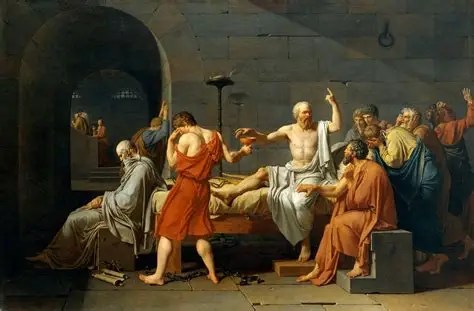
Socrates did not write a single book, and he never published articles in any reputed journal of his times. He did not even start universities like his predecessors. Still, he is considered as the father of Western philosophy. There were philosophers in the ancient Greece before Socrates who were called as pre-Socratic philosophers. In this article, I try to highlight the significance of the philosophy of Socrates in the times of technology and artificial intelligence. I think that his philosophy or way of life is still relevant.
Pre-Socratic philosophers are the thinkers who existed before Socrates. Pre-Socratic philosophy is an umbrella term used to denote the thought of various philosophers like Thales, Parmenides, Anaximander, Anaximenes, Heraclitus, Pythagoras, and so on. We do not have access to any of their writings. Socrates found that the natural philosophy of pre-Socratics lacked a technology of self or meaning-making mechanism. Philosophy of Socrates is a radical departure from the tradition of the pre-Socratics who were concerned about the ultimate stuff (arche) out of which everything else is created. They can be called as scientists in the modern-day terminology as they had deep scientific temper in their approach to the world. The concern of Socrates was not anything like metaphysical questions, but he was deeply concerned about the technology of self or the way to live a meaningful life. His entire philosophy can be summarized with this quote: “An unexamined life is not worth living.”
Socrates is known as the philosopher of the marketplace. He was never like an academic philosopher of our times, but he used to hang out with young people in the market. He engaged in deep conversations with people who claimed to be experts in different domains. His method of conversation is generally called as “dialectic” which proceeds through questioning. For example, in the Dialogue titled, Euthyphro, Socrates is engaged in a conversation with Euthyphro who claimed to be an expert in moral theology. Socrates asked Euthyphro to explain “what is piety?” but Euthyphro failed to give him a convincing answer. Socrates found internal contradictions in every response given by Euthyphro. Towards the end of the Dialogue, Euthyphro comes to know that it is impossible to give a definition of the concept of ‘piety’ and he escapes by saying that he is busy with some other work. In general, Socrates dragged the interlocutors to ‘aporia’ which is a kind of intellectual perplexity where you are not certain about your own set of beliefs. It is believed that Socrates was always in aporia and he tried to spread it around him. He was considered to be the wisest of all Greek men. Socrates acknowledges that he is considered to be wise by the deity because he knows that he does not know anything. According to Socrates, the greatest of all knowledge is the knowledge that we do not know anything. This idea is similar to the Advaita view that highest knowledge is the knowledge of no-thing.
(to be continued)
Shibin Joseph, IIIT Delhi
 KALA
KALA 
Leave a comment