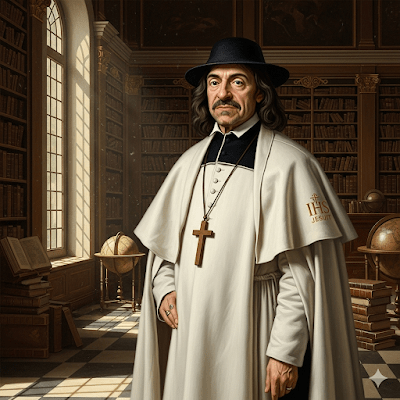
In this article, I try to highlight the similarities between the method of philosophy of Descartes and the spiritual exercises of St. Ignatius of Loyola, the founder of the Jesuits. This investigation is based on my ten years of life as a Jesuit in India and my reading of the philosophy of Descartes. In the first section, I will give a brief introduction to the philosophy of Descartes. In the second section I will introduce the Spiritual Exercises in the spiritual tradition of Jesuits. In the third section, I will discuss some of the common metaphors and tools in both these traditions. I will conclude this article by highlighting the major and essential difference between the two traditions.
Philosophy of Rene Descartes
Rene Descartes was a 17th century French philosopher. He was foundationalist who believed in the need for a solid and unshakable foundation for the study of knowledge. He questioned his system of knowledge and found that it was built on opinions. He felt the need to deconstruct his system of knowledge and to reconstruct it on something that is certain and indubitable. His systematic meditations led him to the idea that everything other than his own existence can be doubted. He understood that his own existence as a doubting being cannot be doubted. He is well-known for developing the signature concept of “cogito”. Anyone who reads the history of Western philosophy will come across the concept of cogito. What is cogito? It is the short form of the famous Cartesian Dictum “cogito ergo sum” which is translated as “I think therefore, I am” or “I doubt therefore I exist”. Descartes found that there is certainty regarding the existence of the subject because the subject should exist in order to doubt. Descartes then builds up a system of knowledge based on the certainty of the existence of the self.
Descartes is also responsible for making a clear statement of the mind -body problem. He divided the reality into material reality and mental/spiritual reality. Material reality is the subject matter of the natural sciences and the mental or spiritual reality is the subject matter of theology and philosophy. Descartes was a Catholic and his concern was to defend his religious faith in the background of the decline of the power of Catholic faith during the scientific revolution in the 17th century Europe. Descartes was not a theologian. His focus was on making the Christian doctrine philosophically sound and relevant. Cartesian dualism was compatible with the worldview of the Catholic Church. The Church makes clear distinction between the mind and the body. Mind has very much theological connotation in the church as it is the manifestation of the indwelling of the Holy Spirit. There is a primacy of Spirit in Church which eventually side-lined the material dimension of human existence. Soul is considered to be a prisoner of the body. Later, Paul Ricoeur commented that Christianity is the Platonism of the masses. Even though Descartes tried to defend Catholic faith, he had to face severe censorship from the Church. Th church put his books in the list of the forbidden literature of the Church. His writings were not acceptable to the Church as his thought emphasized a mechanical philosophy of nature which sidelines God. still the Cartesian version of dualism is dominant in the catholic church and I think that almost every Christian is a Cartesian in some sense. Jesus tells his disciples during his final prayer and Gethsemane: “The soul is willing but the body is weak.”
Spiritual Exercises of the Jesuits
Jesuits is a catholic missionary congregation which was founded in Europe during 16th century. Two students of Paris University named Ignatius of Loyola and Francis Xavier were the major founding fathers of the order. Their founding vision was to defend the doctrines of the Church. Later it got diversified to educating the young, preaching the gospels, and promotion of social justice. At present Jesuits are working in different parts of the world.

The Spiritual Exercises is an important aspect of Jesuit formation and Jesuit life. It is the essence of Ignatian or Jesuit spirituality. It aims to deconstruct the value system of the individual based on the worldly standards and to construct a new set of values based on the Gospel of Jesus Christ. In short, the aim is to reconstruct the life of a Jesuit on a solid and unshakable foundation. The Spiritual Exercises is introduced to the young Jesuits in the very beginning of their formation. It helps the Jesuits to examine their lives and set of values, through a careful inner perception in silence. It thus leads to the discovery of a solid foundation on which the Jesuit life can be built. The Spiritual Exercises is a method of meditation practised and promoted by St. Ignatius, the founder of the Jesuit order. It is a series of meditations that lasts for one month. It is divided into four weeks based on the different stages of life of Lord Jesus Christ. There will be five meditations every day for one month. The individual is expected to be cut off from the external world in order to minimize distraction. The individual needs to do all these meditations in silence, preferably in his chamber or in any private place for prayer. The ultimate aim of the Spiritual Exercises is to discover Jesus Christ as the Saviour of the individual and to ask for the grace to follow him closely in the Jesuit order by renouncing everything else. I had the privilege of doing this one month Spiritual Exercises during my short life as a Jesuit. The Jesuit spiritual masters even offer and direct Ignatian Spiritual Exercises to the laity outside the Jesuit order. The Spiritual Exercises is basically a perception into the inner life of the individual in silence by bracketing the outer life in the society.
Descartes and the Jesuits
I did the Spiritual Exercises about five years before reading Descartes. My second encounter with Descartes at a later stage led me to the discovery of some common metaphors and tools in these two domains. It seems that Descartes inherited these metaphors and tools from his early academic training under the Jesuits. Descartes studied at La Fleche which was a Jesuit institution. Jesuits were known as the educators of Europe. They established educational institutions across Europe in order to inspire young men to Jesuit mission in Asia and Africa. The Jesuits used to introduce the key aspects of the Spiritual Exercises to their students during their retreats. It is possible that Descartes too came across Spiritual Exercises during his early education under the Jesuits.

Some of the metaphors and tools in the Cartesian method show a close affinity between Descartes and the Jesuits. I will now highlight some of the common metaphors and tools that I found in the Spiritual Exercises of the Jesuits and the method of philosophy of Descartes.
- Foundationalism – Both Descartes and Ignatius were revolutionaries in their individual domains. When Ignatius revolutionized the Christian spiritual tradition with his Spiritual Exercises, Descartes revolutionized the western philosophical tradition with the concept of Cogito. Both of them faced severe censorship from the Church for challenging the status quo and the dominant view of the Church. The Jesuit order was suppressed in 1773 for alleged anti-Church thinking and theology and it was later restored in 1814. Both Ignatius and Descartes were foundationalist in different senses. Ignatius was a foundationalist in Spiritual life and Descartes was a foundationalist in knowledge. Both of them were convinced about the need to deconstruct the existing structure in order to build a new system on unshakable foundations. Both of them divided the reality into material reality and spiritual reality. Descartes withheld the external world in his pursuit of the cogito but St. Ignatius renounced the material world in his pursuit of the spiritual foundation.
- Method of doubt – Both Ignatius and Descartes were masters of doubt. Doubt played a key role in their individual pursuits. Both of them did not take anything for granted. Ignatius was always doubtful about the source of consolation during the Spiritual Exercises. He believed that consolation can also come from evil demon and if there is no proper discernment regarding the source of consolation, the individual may be misled in his spiritual pursuit. He strived for certainty regarding the source of spiritual experiences. His companions considered him as a deeply scrupulous person. He asks the individuals to pray to the trinitarian God for confirmation: “Eternal father confirm me, eternal son confirm me, eternal spirit confirm me.” He always emphasized certainty regarding the source of consolation in his own life. Doubt is a central tool in the method of Descartes. He strived for something that cannot be doubted in order to build his new system of knowledge. And both of them turned to God for certainty. God is not a deceiver in the worldview of both of them.
- Evil demon – the metaphor of evil demon is present in both Descartes and Ignatius. It is a deceiving entity in both of them. This aspect is definitely a stumbling block in the path of the seeker. The evil demon is a perennial problem in our pursuits. The evil demon is projected as a powerful entity like God and it requires more effort from the part of the seeker to have certainty.
- Optimism concerning inner perception – both of them affirmed the possibility of inner perception and non-inferential knowledge concerning the contents of mind. It is evident that both of them were convinced about privileged access to the mental states. They begin their meditations by taking an inventory of the contents of mind. Ignatius used the term “movement of spirits” in order to denote the activities in the mind and he emphasised the constant need to do an “examen of conscience” in order to find what is happening in the mind of the seeker.
- The idea of meditation – the idea or practise of meditation is common in both of them. Descartes proposes six meditations in his work entitled Meditations on First Philosophy. The Spiritual Exercises consists of the meditation points for a period of one moth. It is a systematic instruction concerning the method of meditation. Both of them held the view that only a trained mind can find an unshakable foundation. Spiritual exercises is a tool for training the mind by bracketing the external world and its values. Both of them use meditations in different senses. It seems to be a metaphor in Descartes but it is certainly meditation in the literal sense in the Spiritual Exercises of St. Ignatius of Loyola.
Conclusion
In this article, I tried to highlight some of the similarities between the method of philosophy of Descartes and the method of Spiritual Exercises of St. Ignatius of Loyola. I discussed some of the similarities between the two traditions based on my personal encounter with the two distinct traditions. The purpose of the article is not to reduce the philosophy of Descartes into the religious worldview of the Jesuit tradition. My major claim in this article is that some of the metaphors and tools used by Descartes are rooted in the Spiritual Exercises of St. Ignatius of Loyola. It is based on the assumption that Descartes was introduced to the Spiritual Exercises of the Jesuits during his early academic training and the Jesuit metaphors had a long-lasting impact on the thinker. As far as I am concerned, there are no explicit statement from Descartes regarding his Jesuit affiliation and the source of the metaphors and tools used by him in his method of philosophy. More research is required to figure out the implicit statements regarding his indebtedness to other traditions for metaphors and tools. The basic difference between Ignatius and Descartes is that Ignatius negates the ego in the pursuit of the Divine foundation and tries to overcome the material world but the latter affirms the primacy of the individual subject as a thinking thing and withholds judgements concerning the external world.
Reference:
Descartes, Rene. Meditations on First Philosophy
Loyola, Ignatius. Spiritual Exercises
by,
Dr. Shibin Joseph
IIIT, New Delhi.
Enjoyed reading! Please support me. https://buymeacoffee.com/josephkala


 KALA
KALA 
Leave a comment