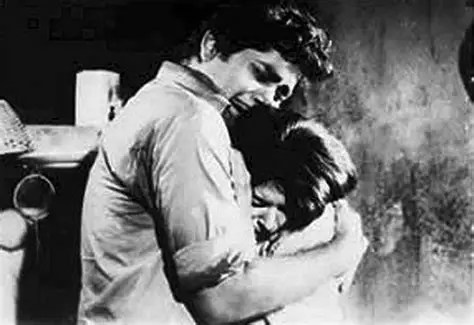
Swayamvaram is the first film of Adoor Gopalakrishnan who raised Malayalam films to the standards of the World Cinema. It discusses the possibility of a meaningful life in a world which appears to be broken. It is more than a love film and it depicts the contradiction between expectation and reality in love.
Swayamvaram did not make any impact during its first release, but it gained more attention as it gained national awards for: best director, best cinematography, and best actress.
Swayamvaram literally challenged the film concept of the Malayali audience. It followed a different trajectory from the conventional film-making. As a result, it was widely criticized by the orthodox film critics of Kerala. It did not have any aspect of comedy, music and dance. What is special about Swayamvaram, then? It is rich with images. The viewer has to read between the lines.
Madhu and Sharada literally lived their characters as Vishwam and Sita. In a nutshell, Swayamvaram tells the story of a couple who eloped to the city to build a new life. Watching this film was indeed a draining experience for me.
Swayamvaram tells the story of the attempt to make meaning in a times of severe meaning crisis emerging from unemployment, sexual ethics, and anxiety. The story is narrated from the perspective of Sita, the wife of Vishwan. Sita appears to be a bold woman but Vishwan appears to be a doubtful person. The skepticism of Vishwan did not permit him to build a successful career in the city. Sometimes he is found to be indifferent and depressed. There is a scene where Vishwan indifferently watches a protest demonstration by a huge number of workers who had lost their jobs. It seems that Vishwan did not find any meaning in joining the workers to raise a collective voice against unemployment. As a result, he succumbs to a normal fever. It seems that poverty substantially drained his physical and mental health. In contrast, Sita appears to be a bold woman. She never regretted eloping with her beloved, Vishwan. She refuses to go back to her parents when Vishwan dies. She metaphorically represents the Hindu religious character of Sita of Ramayana.
The film has an open ending. We do not know whether Sita decides to commit suicide along with the child or she boldly decides to face life. The film ends with the visual of Sita staring at the door which is locked from inside. She must be anxious about any possible knock by men from outside who have been waiting to eat her flesh.

Watching Swayamvaram indeed is a draining experience. And I think that Swayamvaram is the best of Adoor where he discusses the meaning crisis of our times. As a philosopher, Adoor says that ultimately we are alone. Even though we decide to write the story of life with someone else, eventually we need to write the story of our lives on our own. As Heidegger says in Being and Time, anxiety individualizes us.
By Dr. Shibin Joseph, IIIT New Delhi




 KALA
KALA 
Leave a comment