
My first impression of Kolkata came from the book “City of Joy” by Dominique Lapierre. The image of the rickshaw puller got deeply imprinted in my mind. When I was in JNU for my research, I used to guide many students from different parts of India to prepare for JNU entrance examinations. Some of the students from Jadavpur university invited me to Kolkata. I spend a lot of my personal time for helping these students to actualize their JNU dreams. Finally, I decided to visit Kolkata soon after my PhD thesis submission in January 2023. One of my students named Shreya agreed to make every arrangement in Kolkata.
I took a train from New Delhi in a winter afternoon. Unfortunately it happened to be the worst train journey I made till today. The trains were running late due to thick winter fogs in north India. I waited on the railway platform for nearly 12 hours to board the train. Once I boarded the train, I realized that I had no blanket with me to use at night. An old Bihari lady who sat at the edge of my berth shared her blanket with me. By the time I reached Howrah station of Kolkata, I almost got exhausted. The train was late for around 20 hours. The only pleasant part of the journey was the green and fertile fields on both sides. Some Bengali men interacted with me and showed me many plant species and mustard flowers. Being a birdwatcher, I was much interested in spoting exotic birds on the way.
Shreya received me from Howrah station. It was late in the evening. I found very difficult to spot her in such a crowded station. Fortunately, she spotted me lost in the crowd. She was in a cream colored jacket. She dragged me to the nearest bus station. When she knew that I was hungry, she went out to purchase some biscuits for me. She came back with a packet of cake and started to explain about Kolkata. We had our dinner from a restaurant near JU. The walls of the restaurant were filled with images of Tagore and Kolkata city. Her friend named Samik came and took me to his flat. He appeared to be very nervous. He took me to his room somewhere near JU. Since I was really tired, I was not interested in observing many things that evening. Shreya promised that she would meet me on the next morning and left for her flat. I fell asleep very soon in an unfamiliar bed in a strange city.
When I woke up in the morning, I found two guys were sleeping on the next bed. I concluded that it was a two shared room. As I glanced through books in the shelf and on the table, I found a number of books related to physics. I found a guitar in the room. Bengalis are proud of their aesthetic tradition and most of them will be well-versed in at least one art form. They are very proud of their Poet named Rabindranath Tagore. Even though he wrote his poems and stories in Bangla, his works gained much attention from different parts of the world. Eventually his works were translated into multiple languages. I studied Malayalam translation of a poem from his work titled “Gitanjali” which means the musical offering:
“I know that thou takest pleasure in my singing,
Only as a singer I can come before your presence.”
As I was pondering over these lines, Samik and his friend woke up. We had a short chat and we went out to have tea and breakfast. Samik and his friend appeared to be very cordial. I communicated to them in English. I found that both of them were not much comfortable with English. The Bengali elites in Kolkata are known as “bhadrolok” which means the great people or the cultured people. The British, during the colonial occupation, trained many Bengali upper caste people in order to make them their loyal servants. These trained Bengali people stayed very committed and loyal to the British. Certain Bengali upper class surnames like: Sarkar and Biswas were given by the British to the local servants. Calcutta, the earlier name of Kolkata, was the administrative capital of British India. Some leftovers of the British tradition can still be found in Kolkata. As a result of the training in English, Bengalis pursued higher education and research. At present, the Bengalis can be found in every top academic institutions in India and abroad.
I found that the streets of Kolkata are kept very clean. I enjoyed hot tea and Parota from a roadside shop along with Samik and his friend.
Shreya came a little later and took me to show various parts of the city. I found that I can read a bit of Bangla. Bengali script is very close to Hindi script. More than that, Bengali language sounds much similar to my mother language, Malayalam. In addition to that there are a number of similarities between the cultures of Kerala and Bengal. Communist ideology and fish in the diet are the two major connections between these two states which are thousands of kilometers apart.
I heard the phrase “theek achhe” everywhere around. It means okay!
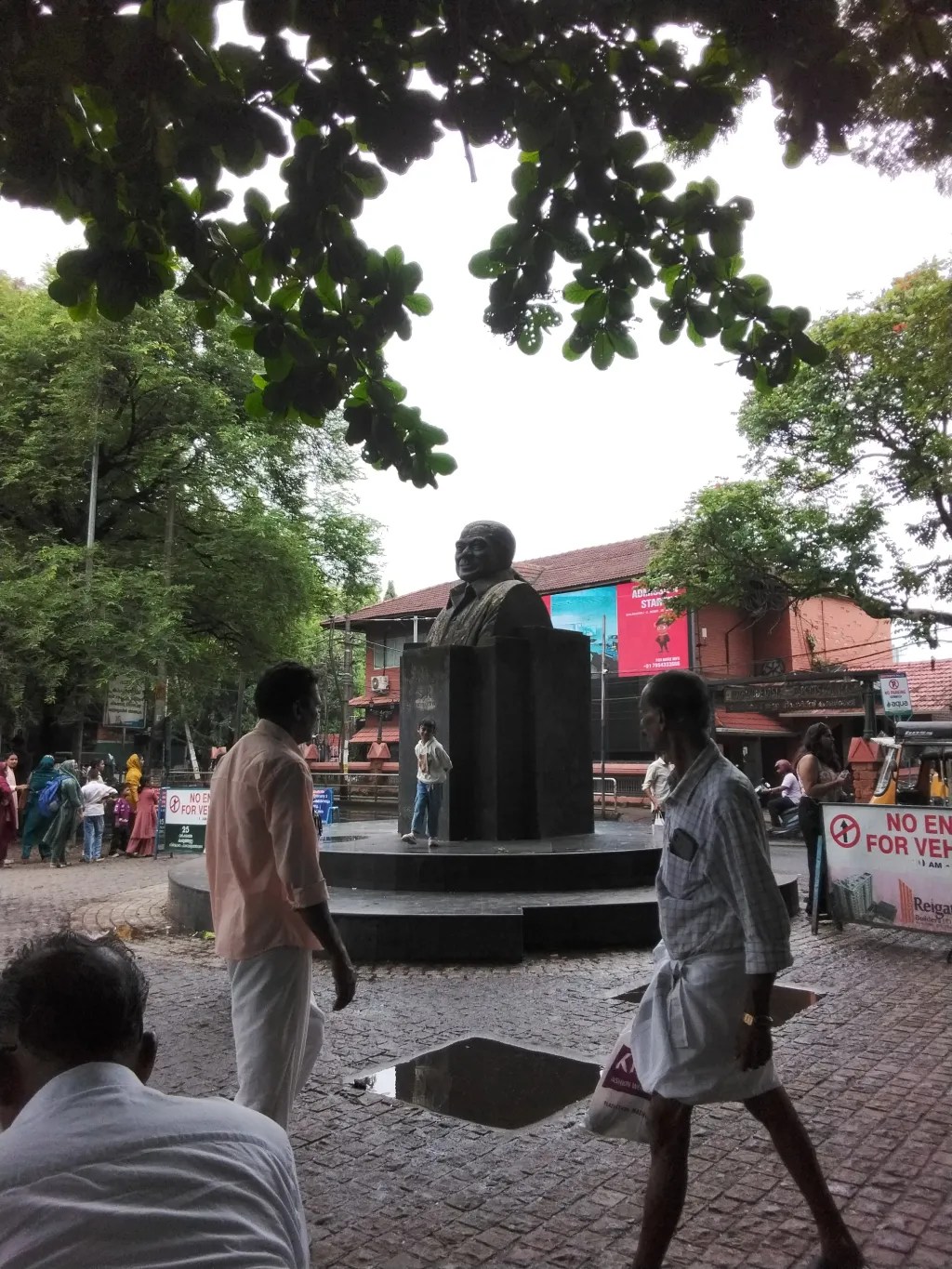
We got into Kolkata metro train. It is believed to be the first metro service in India. Shreya took me to Tagore museum. There’s a tall statue of Tagore outside the building. Shreya had brought some cooked food which she shared with me. I found some cute dotted doves in the meadow nearby.

We then moved to iconic Victoria memorial which symbolizes the British past of Kolkata in particular. I did not want to go closer but decided to enjoy the ambience from the medow outside. Even though she is an artist, Shreya hardly talked about the artistic things about Kolkata. I found that she is indifferent to many things happening around her. She must be also going through the anxieties of our generation. She told me that she tries to be self dependent by offering home tuitions. She goes to the student’s homes in the evening for tuitions.
As we were about to leave, I located the tall tower of a Christian church nearby. I really wanted to visit the church premises but I sensed that she was not interested. Meanwhile I texted some students in Jadavpur university so that I could meet them in the evening. They welcomed me to the campus so that I can meet some professors in the philosophy department.
Shreya dropped me in JU campus and left for home tuitions. I contacted the same students so that I feel comfortable on campus. Unfortunately, none of them replied even after many hours. I used to spend many hours online for these students for their academic needs. My services were totally free. I began to observe the students moving around and the birds in the lake behind me. I spotted a few cute water birds. Even though I was sitting there for a few hours, no student came forward to interact with me. I just initiated some conversation with the students who were around but they did not show much interest in me. A Communist activist came my way to paste some poster. JU can be called as the JNU of Bengal. Many of the committed Communist activists in JNU are from Bengal. I was optimistic about a fruitful conversation with the activist. She responded to my questions and her answers were not open ended.
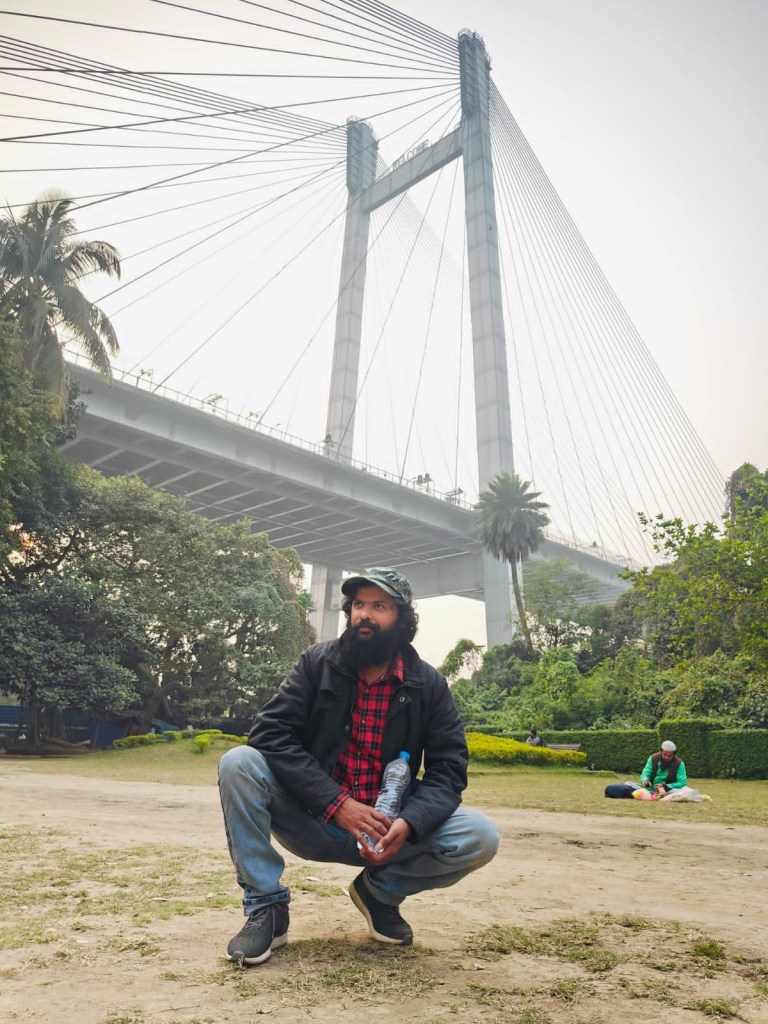
Meanwhile Shreya returned after her tuitions. She felt bad to know that no students showed up to take me around. She took me around the campus. JU campus is more like JNU, it is smaller than JNU but I found more students activity happening around. She took me to a room where she introduced me to some political activists who were engaged in a poster work. When Shreya gave a brief introduction about me, some of them looked at me for a few seconds and continued their work. Unlike JU, JNU students are very welcoming to outsiders and they creatively and actively engage with them. If you are ready to socialize, you will never feel out of place in JNU. As I was getting out of the room, a random student came to me and talked to me as if we were already in touch. He said that I had helped him online for JNU entrance and he recognized my by my camouflage cap.
“Thank God of Nietzsche, at least one soul has acknowledged me.”
As we were having dinner from a roadside restaurant, Shreya said that Samik is not ready to accommodate me for that night. I did not understand the reason behind the sudden change of mind. They arranged a temporary night stay for me with some medical students, about two kilometers away. I just felt that things were not happening as I wished. I booked a flight ticket to Kerala before going to bed. The medical student in the room was very cordial to me. He offered me some biscuits and then showed me a bed to sleep. I took a little Time to sleep as I became anxious in a strange city.
It is said that you will find a Malayali anywhere in the world. Malayalees have a unique capacity to go anywhere and adapt According to the situations. One interesting thing about Malayali is that he will adopt any culture anywhere in the world but keeps his Malayali essence unchanged. What are the essential features of a Malayali?
It is difficult to define the essential feature of a Malayali. I learned from my experience that a Malayali is a Malayali wherever she is.
I came to know that there is one Malayali student in Jadavpur university. I traced him within a day. When he came to know about my sad situation, he agreed to accommodate me. I came to know that he was from my home district. Just like me, he too does not hang out with Malayalis when he is outside Kerala. He lives in a flat with a few Bengalis in a calm and quiet corner of Kolkata. That is one thing beautiful about Kolkata. It is not a stressful city like Bangalore, Mumbai or Chennai. Asif offered me a bed in his flat and slept peacefully for the first time in Kolkata.
When I woke up in the morning, Asif and his fiends were still sleeping. They go to bed very late in the night and sleep in the morning hours. I went to their balcony to observe the surroundings. The balcony was very spacious. I found a few beedi and cigarette buds on the floor. It’s Indeed a perfect place to light a cigarette and chill. There was an abandoned children’s park right in front of his flat. I spotted a few rock pigeons there. Rock pigeons are so common in Indian cities that they have almost become unnoticed by Indians.
It was the morning school time. I heard a loud “theek achhe” shout from a student. I found a few school vans parked in front of the flat. Many students were slowly moving towards a nearby school. Suddenly I heard the noise of some object falling from a moving two wheeler. Someone’s lunch box is on the road. Almost everything came out of the box. Indeed there was a big piece of fish lying on the road. I felt pity for the man on the two wheeler. Fish is very important for Bengalis. A rich fish diet is something common between kerala and Bengal. As I was lost in the thought about fish in Bengali culture, the man parked the two wheeler and came to the food particles on the road. He just ignored everything else, collected the piece of fish, kept it safely back in his lunch box and continued his ride.
(To be continued)
By
Joseph Kala


 KALA
KALA 
Leave a comment