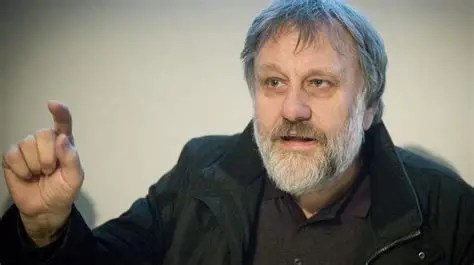
Father Sebastian Kappen and Slavoj Zizek are two thinkers with many similarities in their intellectual pursuits. Both are fierce critics of global capitalism and think that Marxism and Christianity can be reinterpreted for the fight against it. Also, both are influenced by Hegelian dialectic. In the critique of Christianity, both of them take different paths but eventually come to almost the same conclusions.
Christ of Zizek
The book Monstrosity of Christ is the result of a discussion between Zizek and the famous theologian John Milbank. In it, Zizek re-interprets Christ and the Trinity in the Bible in the light of Hegelian dialectic. It contains several psychological insights into humans and society.
From God to Christ
The incarnation of God is one of the most important narratives in the symbolic order of Christians. Zizek sees it as a denial of the transcendent God acting behind the curtain. God renounces his position and transforms himself into one of his creations. Christ the God-man continues to be human until his death on the cross. Thus the Supreme Being, who sits outside the universe and constantly watches over us humans, disappears. Humans alone become responsible for everything that happens here on earth. Finally, the death of Christ on the cross is the death of God. So, it is no longer possible for a man to become God – to merge and be one with Him. We can identify with Christ alone. Thus, the dialectical transcendence of God to man takes place in the incarnation.
Holy Spirit
After the death of Christ, the father-God transforms through the Son to the Holy Spirit. The Creator of the universe unfolds Himself in the community of believers. There is no longer a hidden God, nor a Son of God, but only the Holy Spirit. That is what is revealed in the early Christian communities of the New Testament, which Engels considers an example of Primitive Communism. Christ says, “When you are gathered in my name, I will be there with you.” That ‘I’ is the Holy Spirit.
To get a better grasp of the Spirit, we need to know more about humans. The individuality of and the person in each of us are not the same. As a person, I am defined by my natural, physical, and mental characteristics. That’s not what makes me a unique person. There is something in a human that cannot be reduced to a part of nature and that is what makes one a person. It is the basis of human freedom and uniqueness.
As a member of Christianity, one attains his/her unique personality in Holy Spirit. This united spirituality is the Objective Spirit (Lacan’s big Other) of the Hegelian dialectics of Nature. When a person becomes a part of it, the perception that he/she is only a distorted image of God changes and a new subjectivity emerges.
Trinity through History
The God of the Old Testament frees his people from slavery and constantly gets involved in history. But there is no such God in the symbolic order of the West today. What remains there now is a God isolated in the transcendent beyond, inaccessible to humans. He has no role in a world governed by scientifically sound natural laws.
It is enlightenment that led to this situation. It branded all religious beliefs as superstition and expelled them from social life. It was granted theological justification by Thomas Aquinas in the Catholic Church. He banished God beyond our finite world as a mystery beyond reason. However, he logically established that God’s signs could be seen in the finite world. Thus the God of the Bible, who revealed himself by involving in human history, is now thrown out of history.
In the Protestant churches, all that exists is divided into two spheres – the godless finite universe where Reason rules and the infinite beyond, the realm of God. Humans have only two choices. Either deny the transcendental domain of God and be confined to Reason and the material universe. Or, withdraw from the realm of Reason and seek refuge in religion and spirituality.
These changes led to a conflict between philosophy and religion. As Hegel defines, philosophy is the enlightened reason. At first, it seemed that philosophy prevailed. With the advancement of science and reason, religion was reduced to a matter of human emotions.
However, with the expulsion of religion by Reason, the scope of inquiry for science narrowed, and it turned into mere natural science. The limitations of scientific knowledge led to the return of faith. The gap between knowledge and faith reappeared.
Today, Reason is reduced to intellect, an instrument that can be applied to material things. And religion is reduced to an ineffective inner belief. All the mystery of the universe is lost. The God beyond our reach is not the old God of history.
Thus, Zizek shows that the ultimate achievement of enlightenment is the complete nullification of human subjectivity. The subjectivity, inflated by modernity is thrown to the ground. The steering of human history is controlled by the world market. It is in this context that the re-reading of Christian narratives becomes relevant.
The revolutionary nature of Christianity
Let us come to Christianity in the light of the Hegelian interpretation of the Trinity. Facing death, Christ asks his disciples, “Can you drink of the cup that I am drinking?” This shows that God incarnate is more oppressed than we humans. For a Christian, the biggest sin is to stagger in faith. But what did Christ lament on the cross? “Father, have you forsaken me?” He was wavering in his faith in God, his father.
All of this shows that God that we can imitate is a sinner and persecuted. It means that we have no right to be inactive out of fear of sin or persecution.
Zizek compares a dream interpreted by Freud with the lament of Christ. A weary father falls asleep next to his son’s coffin. Then the son appears in a dream, wrapped in flames, and asks, “Dad, don’t you see me burning?” On waking, the father observes a cantle turned down and the coffin shroud burning. The psychological interpretation is that the father’s guilt for his son’s death is behind this dream.
Zizek likens the lament of Christ on the cross to that Son’s question to the Father. It is the question of the human son to the divine Father, who is hiding behind the scene, justifying all our sufferings. He takes the responsibility for all our sins. And then confronts the Father, knowing that it is futile.
The Bible tells us that, as soon as Christ died on the cross, the earth shook and the sun became dim. But Zizek says that it must have happened during the aforementioned lamentation of Christ. Those words belonged to a God who had forsaken himself.
Zizek says that if you are a revolutionary, you will not find another god in the world who struggles with himself as you do.
Suppose you are an atheist. There is loneliness and isolation that you feel within and outside. Is not Christ the one who cried out such a feeling of loneliness on the cross – the God who seems to be an atheist for at least a moment?
The atheist God, who denies himself, who dies in persecution, and who is lost in his creation, is also a revolutionary. This is what makes Christianity unique and most revolutionary among all religions.
Christ and Job
Zizek points out an interesting similarity between Christ and Job in the Book of Job. In all other books of the Old Testament, humans are insignificant in front of God, who rules over all that is. But Job asks God, a Christ-like question: “What is God’s purpose?” The problem is not whether he got the answer or not. Job is satisfied by asking this question in a way that no one else dares. Here what is revealed is his subjectivity that does not fade even when he is very sick.
Zizek says that Job, who did not get an answer to his question, remained silent, not because of God’s frightening presence, but because he realized the helplessness of God. His silence was a declaration of unity with God.
We see in the Book of Job, as in Christ, the death of the good God who rewards all our good works. The only Christian answer to the question of whether God existed in Hitler’s gas chambers is as follows: “Christ was there as a helpless God – a merciful observer.”
What is the Holy Spirit?
The Bible says that the Holy Spirit dwelt among the Disciples of Christ, radically transforming them. Zizek compares that transformed discipleship to the collective subjectivity of the revolutionaries, which in Marxian philosophy is united by praxis. It is through such communities that the Holy Spirit attains reality. This means that the Spirit is virtual reality. It can only be said to exist when human beings act as if it exists. It acts as the substance of persons that identify themselves in it – the foundation of their existence and the horizon of the ultimate meaning of life. It is something that humans do not hesitate to protect, even at the cost of their lives. Zizek likens it to communism. What exists is not communism, but only the people who believe in it. In the same way, the intangible Spirit is real when persons believe in it and act accordingly.
Hegel describes the Spirit in the dialectical evolution of Nature: “it is in the finite consciousness that the process of knowing spirit’s essence takes place and that the divine self-consciousness thus arises. Out of the foaming ferment of finitude, the spirit rises fragrantly.” (Hegel, Lectures, Vol.3, p.233). This is also the case with the Holy Spirit. Our consciousness, the self-consciousness of finite humans, is the source from which the Holy Spirit emerges.
Relevance Today
Those who claim to be Christians today generally see God as the Most High, the Merciful, who gave his Son as a token of His infinite love. This leads to a kind of inward spirituality that makes religion irrelevant in socio-political life. In today’s global capitalist context, such spirituality is gaining strength in other religions as well.
There is another type of spirituality that abandons organized religions and resort to individual spiritual practices like meditation. Zizek sees this as the most suitable ideological support for global capitalism today. Having explained all this, Zizek claims that he, the materialist, is a greater Christian than the theologian with whom he had the dialogue.
Jesus of Kappen
Zizek focuses on Christ in biblical stories and the concept of the Trinity as produced and propagated by Christianity. But Kappen focuses on Jesus, the self-proclaimed Son of Man, subdued and hidden behind all Christian ideological edifice developed in the course of history. Christ is Jesus remolded by Christianity as the Messiah.
Kappen highlights the revolutionary prophet, appearing in the words and deeds of Jesus. In its light, he criticizes Christianity and its God. Like Zizek, Kappen too denies the spirituality of passive introspection. Its God of worship is likened to the world market and the craving for the Hereafter to consumerism.
In his last writing (Kappen, Vol.6, Chap.11), Kappen refers to the God of Christianity as the Christian Ungod and replaces the term God by the Divine. This is where Kappen meets Zizek.
Once at a conference, someone asked if Kappen believed in God. His reply was, “I do not believe in a God that created and rules over all that is. But the lamentation of the starving people from the streets deeply disturbs me. My God is the source of that disturbance.”
In his later years, Kappen further develops the same concept of God as the Divine.
As we have seen, Zizek likens the Holy Spirit to communism. Communism projects a classless society – a new world with no private property or discrimination between human beings – in which the state will wither away. Jesus too preached about such a new heaven and earth and he was killed for that. That new world is what he calls the kingdom of God, and proclaims its presence here and now.
To Kappen Jesus’ kingdom of God is not much different from Marx’s classless society. The Divine provokes humans to strive for its realization. It confronts us in everyday life in two ways – as a gift and as a challenge. He writes, “Divinity appears as a gift in all experiences that enable us to transcend ourselves and open new horizons of reality and transcendence.” And that “where the sanctity of the earth is questioned, or where man is trampled, divinity faces us as a challenge.” Only through those who accept this challenge can the Divine become what it is – like the Holy Spirit of Zizek. In today’s world, Kappen sees the manifestation of the Divine in the ‘rising struggles of helpless and neglected human beings such as Adivasis, Dalits, tribals, and women.’
Another article by Kappen is about the symbolic revolution (Kappen, Vol.6, Chap. 3). Symbols – myths and master signifiers that achieve steady meaning in the symbolic order – have a great influence on the life of a people. Their unconscious influence on the people is what Zizek calls ideology.If there is to be a fundamental change in society, there ought to be radical changes in the sphere of ideology. For that, the symbols have to be restructured in the light of the new visions about the new world. This is the symbolic revolution that Kappen advocates. This is exactly what Zizek is doing by dismantling the powerful symbols of Christianity and Kappen by freeing the son Jesus of Joseph from such symbols.
By
Sebastian Vattamattam
About the Author: Sebastian Vattamattam is a retired Professor of Mathematics from SB College, Changanachery, Kerala. He is a relative of the late Jesuit thinker Sebastian Kappen.
Reference:
Zizek and Milbank (2009), The Monstrosity of Christ: Paradox or Dialectic?, Cambridge and London: The MIT Press, Hegel, G. W. F., Lectures on the Philosophy of Religion, (Lectures)
Hegel, G. W. F., Lectures on the Philosophy of Religion, (Lectures)
Kappen, Sebastian, Collected Works of Sebastian Kappen, ed. Sebastian Vattamattam, ISPCK, Delhi, 2021



 KALA
KALA 
Leave a comment