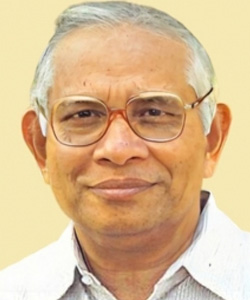
John Vattanky was an Indian Jesuit, educated at Oxford and Vienna and also trained in the rigorous ways of traditional Indian learning. His major interest was in Classical Indian Philosophy, especially Nyaya Logic. Some of his major works are Gangesa’s Philosophy of God and Nyaya Philosophy of Language. He was a professor Emeritus of Indian philosophy and Sanskrit at Jnana Deepa Vidyapeeth Pune, in India. I met him for a short while during my Jesuit training at JDV.
I came across Vattanky during my days with Jesuits in Kerala. Vattanky delivered a guest lecture on the systems of Indian philosophy. Since he introduced philosophy to the students of religious training and spirituality, nobody really understood what he was saying. He told us to never forget the names of the schools of thought in Indian philosophy. I came to know that he was an expert in Modern Nyaya (navya Nyaya). Someone showed me a book written by him titled Gangesa’s Philosophy of God. Gangesa is considered as the founder of modern Nyaya or indian logic.
Vattanky was a Jesuit priest from Kottayam district of Kerala. He was always proud of his aristocratic roots. He took pride in his identity as a Syrian Christian from Palai. He always dressed up in executive style. He always kept a very good standard of life even though he was the member of a religious congregation named Jesuits. He taught Indian philosophy for a long time at Jnanadeep Vidyapeeth, an ecclesiastical university at Pune, in India. During those days, he developed a very good personal library. He gathered funds for his research in Indian philosophy, effortlessly. He had good contacts in Europe. He always promoted intellectual work among the young aspiring Jesuits. Sadly, nobody got inspired by him. His legacy ended with himself. It seemed that he failed to connect to ordinary people and especially to the young Jesuits in training. He could not come down to their levels in order to engage with him. I remember that Vattanky got offended when I drank beer directly from the bottle in a party where he was present. Vattanky was happy to know that I got interested in philosophy. Unfortunately, I was not up to his expectations.
Vattanky was not much appreciated even among the Jesuits of Kerala. Sadly nobody understood him. Vattanky was one of the four key intellectual figures of Kerala Jesuits at one point of time. Sebastian Kappen was philosopher and theologian who was thrown out of the Chruch due to his revolutionary Marxist thought, Samuel Rayan too gained the dislike of the Bishops of Kerala due to his version of Liberation theology. Rayan did not write much. He was a thinker like Socrates who always loved to teach orally. There is only one book in the name of Rayan which is entitled as Power of Holy Spirit. Father Adappoor was a public intellectual based in Kochi who used to engage with the contemporary social issues. Vattanky is the fourth pillar of the Jesuit intellectual traidition, who was radically different from the other three. Vattanky chose to be an Aristocratic Indian philosoher, an orthodox Syro-Malabar Christian, and a servant of the Church. Once he criticized the Jesuits by saying that the Society of Jesus has become an NGO.
During the evening of his intellectual life, Vattanky came back to Kerala in order to launch a new research center for Indian philosophy and oriental thought. He erected a a building in the Samanvaya Jesuit house campus. By the time the work of the center got completed, Vattanky’s health declined. He was taken to Calicut, the Jesuit Old age home, where he breathed his last. The research center built by Vattanky is still functioning at Kanjirapally. There is a library with all the books collected by Vattanky on Indian thought, a few rooms for the scholars to stay and study, and of course, a typical Syro-Malabar style Chapel which was exclusively built for Vattanky to celebrate the Eucharist in Syro-Malabar way.
Even though he could not inspire much younger people, he inspired a few people outside the Jesuit tradition. Many scholars from other traditions showed interest in Vattanky. Some of his students at JDV Pune, got inspired by him. Devasya Antony, a professor of philosophy in Delhi university, is one among them, who wrote on social media on the death of Vattanky:
“Vattanky was undoubtedly a great scholar embodying the Jesuit notion of ‘magis’! During my days of doing theology at Jnana-Deepa Vidyapeeth, Pune, I have met him couple of times and the last I met him was sometime in 2008 at St. Xavier’s Jesuit Residence, Delhi. He was a soft spoken scholar par excellence, a true Acharya in the Indic tradition. Even today the best extant translation of Nyaya-siddhananta-Muktavali (written by the Naiyayika Viswanatha) is the work done by Professor Vattanky! I use this as a reference work for my classes in the University of Delhi. The Indian Sanskrit-Philosophy-Acharya world will be poor without him.” (Devasia Antony)
Indeed, John Vattanky was a prophet who was not valued in his homeland. And he still remains as an underrated Indian philosopher. I hope that Vattanky will be discussed in Indian academia sometime in the near future.
By
Dr. Shibin Joseph, IIIT Delhi


 KALA
KALA 
Leave a comment