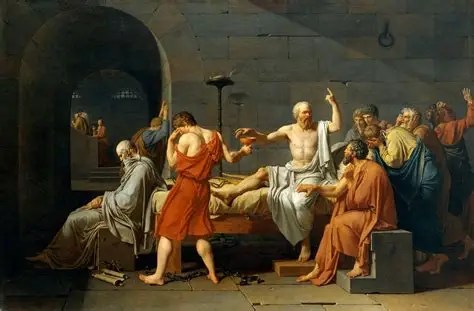
Socrates and Sophists were wandering teachers in Ancient Greece. The aspiring young men of Athens flocked around them. Both of them taught the young people different forms of art and argumentation. It is possible that we get confused between Socrates and Sophists. What were the essential difference between Sophists and Socrates. In this article, I will highlight some of the key differences between Socrates and the Sophists.
In order to know the difference between Socrates and Sophists, we need to have clarity concerning what is philosophy and who is a philosopher. Aristotle says in Metaphysics that philosopher is someone who is the lover of wisdom. The word philosophy comes from the union of two words – Philos (love) and Sophia (wisdom). Aristotle said that majority of the people around us live in the world of sensual pleasure and gossiping without having any individual identity. They can be considered as one in the crowd. They follow the trends of their times, do what others tell them to do, and waste their time in idle-talk. A few others get trained in some special skill (art) and are claimed to be experts in some field. We generally turn to such people for expert advise. For example, there are lawyers, teachers, writers, speakers, politicians, doctors, drivers, carpenters, and the like. All these people are experts in their own fields. These experts generally charge their clients for their service. They love knowledge to make money for better living conditions. Aristotle says that there are some rare people who love knowledge for its own sake and they are called as philosophers. A philosopher is the true seeker of knowledge for he does not have any personal motives in his search for knowledge. That is why philosophers are very rare among us. Hence we can conclude that Socrates was a philosopher and Sophists were experts in some domains of knowledge.
What is philosophy, then? The idea that we gather from the early Greek thought of Socrates and Plato is that philosophy is the search for the ultimate truth, principle or cause of the reality. The quest for the ultimate reality can even be found in Pre-Socratic philosophers like: Thales, Anaximander, Anaximenes, and Pythagoras. The pre-Socratics gave materialistic explanation of the ultimate cause of reality. According to Socrates, philosophy is the search for the ultimate foundations of our knowledge claims. He wants others to tell him the foundation on which they make huge claims. For example, in the Platonic dialogue, Socrates asks question concerning our claims concerning knowledge. In Euthyphro, he asks us to tell him the foundation of our claims of piety. Socrates was skeptical about the possibility of an ultimate foundation for our knowledge claims. He challenged those who believed that there is a foundation for knowledge claims. The Sophists who were the contemporaries of Socrates, believed that there is no need to search for the ultimate foundations or first principles of reality because there is no ultimate principle of reality. They said that we cannot know the ultimate foundation of reality because it may not exist. Some of their major claims are:
“Man is the measure of all things” – It means that man himself is the foundation of all knowledge claims. There is no metaphysical foundation of knowledge. In this sense, knowledge is relative to human beings. There is nothing essentially good or bad and hence we can argue for any side and win the argument.
Protagoras said:
“Man is the measure for all things, of things that are, that they are, and of things that are not, that they are not.”
It means that human being himself acts as the yardstick for evaluating judgement and action.
Relativism about knowledge is an important feature of sophists like Protagoras.
Gorgias
Gorgias is considered to be the master of the art of persuasion or rhetoric.
He said that there is no point in seeking objective truth.
Thrasymachus –
Thrasymachus appears in the Platonic dialogue of Republic which discusses the idea of Justice.
“Justice is the interest of the stronger.”
Sextus Empiricus –
He was a radical skeptic. Sophists propagated thoroughgoing skepticism concerning the possibility of knowledge.
“By skepticism… we arrive first at suspension of judgement, and second at freedom from disturbance.”
“Nothing exists: and, if something did exist, it could not be known; and if it could be known, it could not be communicated.” (Gorgias)
So, the major difference between Socrates and Sophists is that Socrates was skeptical about the possibility of ultimate foundations of knowledge claims but Sophists claimed that there is no ultimate foundations for knowledge, knowledge is relative to human beings and hence we do not seek to seek for objective knowledge.
As I mentioned earlier, both Socrates ans Sophists were wandering teachers of ancient Greece. Socrates said that he does not know anything and hence he was trying to know from the knowledgeable and the wise men around him. He as known as the thinker of the market place. His method of philosophy was conversation. He found that people around him pretended that they know many things. He wanted to show them that they too do not know anything. His method of philosophy was Dialectic which is done through asking subsequent questions to the people who claim to know that they know something. The goal of Dialectic is to reach a state of ignorance which is known as aporia. Almost every Socratic dialogue ends in an aporia or confusion. Socrates did not teach anything to others and hence he did not charge any fees from his students. He was known as an intellectual midwife where his task was to assist the student to search for knowledge on their own. The Sophists taught the young men of Athens, the art of Rhetoric. Rhetoric is an art of persuasion.
What is the difference between Dialectic and Rhetoric? Rhetoric is considered to be the opposite of Dialectic.
Dialectic
It is the method of philosophy according to Socrates, Plato, and Aristotle.
Dialectic is a method to reach the ultimate foundations of knowledge and ultimate cause of reality.
It is a mode of thinking through concepts which is devoid of empirical verification. We have the image of a philosopher sitting alone and being lost in thought.
Dialectic begins with an attitude of wonder, there is a formation of a hypothesis, hypothesis testing, raising subsequent questions, and ends in aporia.
Rhetoric
Rhetoric is the method of philosophy practiced by the sophists.
It is considered to be the enemy of philosophy.
Socrates, Plato, and Aristotle considered Rhetoric as deceptive.
Sophists earned money by teaching the method of rhetoric which is persuasive speech to the aspiring young men of Athens.
Rhetoric is not based on reasoning but it is an appeal to human emotions through the clever use of language. It is just an emotional manipulation.
The Sophists could convince anyone with their convincing arguments and clever use of language. But Socrates, Plato and Aristotle believed that Rhetoric gives the impression that it is rationally sound but we find the lack of content or emptiness deep inside. Basically rhetoric is deception through language.
Conclusion
Both Socrates and Sophists were engaged in similar activities but not the same activity.
Socrates practiced Dialectic which is rational arguments through concepts.
Sophists practiced Rhetoric and they taught rhetoric to the young politicians of Athens to make money. Socrates was a lover of wisdom but Sophists loved wisdom to make money.
Socrates and Plato argued that the claims of Sophists are based on ignorance. They found that rhetoric is used to please the crowd rather than enabling them to think critically.
However, Plato and Aristotle were not completely against rhetoric. They acknowledge that rhetoric is a powerful mode of communication and persuasion that can be reformed. Plato talks about reformed rhetoric in Phaedrus. A clear account of reformed rhetoric is found in the work of Aristotle titled Rhetoric.
Shibin Joseph
IIIT Delhi






 KALA
KALA 
Leave a comment