
I came across John Searle during my research at the Centre for Philosophy, JNU. I was exploring the possibility of a research on the Conceptual Metaphor theory of Lakoff and Johnson. My supervisor advised me to go back to metaphor itself. As I was going through the philosophical literature on metaphor, I reached Searle. I wrote my thesis on metaphor titled “Context-dependence of Metaphor Creation and Interpretation in John Searle and Donald Davidson.” My study was a comparative analysis of the accounts of metaphor of Searle and Davidson. Both of them turned to metaphor in the last quarter of the 20th century. I argued that Searle’s theory of metaphor is a development of Davidson’s rejection of metaphorical meaning in semantics.
Searle is not the first thinker who defended metaphor in analytic tradition. Earlier, Max Black in his paper titled “Metaphor” defended metaphorical meaning but it did not gain attention due to the predominance of logical positivism which considered metaphors as empty statements without meaning. Black argued that metaphorical meaning arises from the interaction between two domains in a metaphorical utterance. For example:
“Man is a wolf.”
In this utterance, the domains of wolf and man interact and there emerges a new meaning. His theory was known as “interaction theory” of metaphor. According to Black, metaphorical meaning is an emergent phenomenon. Black’s project was to defend metaphorical meaning within semantics. He argued that metaphor is a semantic phenomenon which works by violating the rules of semantics.
Donald Davidson, in his influential paper entitled “What Metaphors Mean” argued that metaphors do not mean anything beyond their literal meanings. Davidson did not rubbished metaphors as empty statements as the logical positivists. He acknowledged that metaphors have some meaning which is the literal meaning of the utterance. Davidson rejected Black’s idea that metaphor works by creatively violating the rules of semantics. He argued that metaphor cannot be a semantic phenomenon by violating the rules of semantics. Davidson is well-known for his semantic theory of meaning where meaning systematically emerges from the meanings of the constituent words and the way in which they are arranged. Black wrote a paper titled “How Metaphors Work: A Reply to Davidson” in order to explain his thesis of metaphorical meaning. Davidson did not write another paper to defend his position. Davidson’s thesis was that metaphor is not a semantic phenomenon but it belong to the domain of use. Davidson’s view is widely considered as a rejection of the whole idea of metaphorical meaning. In my thesis, I argued that Davidson is not rejecting the possibility of metaphorical meaning, but he says that metaphor belongs to the domain of use. He seems to say that metaphor is a pragmatic phenomenon.
In my thesis, I claim that Searle’s theory of metaphor is a development of Davidson’s theory of metaphor. Searle explains Davidson’s latent idea that metaphor is a pragmatic phenomenon. Searle claims that his project is to give a non-metaphoric explanation of metaphor. He thought that the problem with Max Black was that he gave us a metaphoric explanation of metaphor. Indeed, we come across a number of metaphors in the theory of Black. There are metaphors like: smoked glass, star of David, and lattice in his explanation of the mechanism of metaphor.
Searle attempted to give a non-metaphorical explanation of metaphorical meaning by drawing insights from the speech acts theory of Austin and Conversational implicature of Paul Grice.
For Searle, metaphors works like an indirect speech act where we say something and mean more than what we say. Searle thinks that metaphor is a rule-governed activity which is against Davidson’s view that metaphor is not governed by rules.
Searle asks:
“How do metaphorical utterances work, that is, how is it possible for speakers to communicate to hearers when speaking metaphorically inasmuch as they do not say what they mean?” (Searle 1979, 92).
Searle found that there are many cases where we say one thing and mean something else. Metaphor, Irony, sarcasm, and indirect speech acts are the cases where we mean something different from what we say. Let us focus on the case of metaphor.
Searle says that the speaker says S is P and Means that S is R. How is it possible to say one thing and mean something else?
For example: I say,
Hegel is a dead horse in the market.
Man is a wolf.
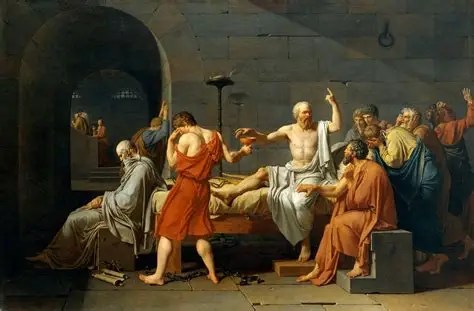
Socrates is a midwife.
I all these cases, I say one thing and mean something else. In order to explain the mechanism behind this mode of communication, Searle makes distinction between Sentence meaning and Utterance meaning. Sentence meaning is the literal meaning of the utterance, that is, S is P. And utterance meaning is the metaphorical meaning of the utterance, that is, S is R.
Searle thinks that there is a systematic connection between sentence meaning and utterance meaning so that we can easily reach the metaphorical meaning. He says:
“How it is possible to say S is P and both mean and communicate S is R where P does not literally mean R. If one can communicate S is R using S is P then the relation between the sentence meaning and the utterance meaning must be systematic.”
Searle argues that there must be a set of principles or strategies shared between the speaker and hearer in order to effortlessly reach the metaphorical meaning from the literal meaning.
He then discusses a three-staged theory of metaphor interpretation.
Stage One:
Check whether the given utterance should be taken literally or not. If it is literally false in the given context, then we need to think about a different level of meaning. In the case of literal meaning, the sentence meaning and utterance meaning coincide. For example,
Hegel is a philosopher – It means that Hegel is a philosopher.
Hegel is a dead horse – It appears to be literally false. Hence we need to look for alternate meanings.
Stage Two:
If the literal meaning appears to be defective, then we need to generate a set of possible meanings of the given utterance.
He lists eight principles and thinks that there can be more which need to be added to the list.
He says that we can derive a range of meanings based on:
Similarities between two things. “Achilles is a lion.”
(Contingent) similarities between properties of two things. “Sam is a pig.”
Similarities based on prejudices/biases. “Richard is a gorilla”
Culturally or naturally determined connection between two entities – “Sally is a block of ice.” It means that Sally is depressed or unemotional.
Similarities between the states of two things or entities – “Ludhiana is the Manchester of India.”
Meaning based on part-whole relationship as in the case of metonymy and Synecdoche.
Stage Three:
It is necessary to identify the most relevant meaning in the given context. The third stage is crucial in determining the most relevant meaning from the range of meanings generated in the previous stage. Context comes into play here.
Searle invokes the Gricean idea of relevance at this stage. According to Grice, we always tend to speak the most relevant thing in any conversation. Conversation is a cooperative activity for Grice and Searle.
Conclusion
Searle is optimistic that his three-staged process of metaphor interpretation can effectively deal with all the metaphors that we encounter in our everyday life. He is open to add more principles to generate a wide range of meaning.
His non-metaphorical explanation of metaphor interpretation seems to undermine the role of imagination. According to Aristotelian explanation of metaphor, imagination is both the cause and effect of metaphor. Searle also seems to say that imagination is the cause of metaphor. He does not use the term imagination but only say that there is some ‘background capacity’ which is responsible for the creation of metaphor.
His account of ‘relevance’ in metaphor interpretation gained more attention in contemporary cognitive science. I argued in my thesis that metaphor is associated with realizing the most relevant information at any given time. It means that we do not need to pay attention to a large ocean of information at any given time which is combinatorily explosive as Verbaeke argues. Metaphor enables us to focus on the most relevant information or meaning at any given point of time.
Reference:
Searle, J. (1979): Metaphor. In: Ortony, A. (ed.): Metaphor and Thought, Cambridge: Cambridge University Press.
Davidson, D. (1979): What Metaphors Mean. In: Sacks, S. (ed.): On Metaphor. Chicago: University of Chicago Press. Reprinted in Davidson, D. (2001): Inquiries into Truth and Interpretation. Second Ed., Oxford: Clarendon Press, 245-264.
Black, M. (1955): Metaphor. Proceedings of the Aristotelian Society 55, 273-294.
Black, M. “How Metaphors Work: A Reply to Donald Davidson.”
by Shibin Joseph, IIIT Delhi





 KALA
KALA 
Leave a comment